Astronomers studying a nearby star say they've found the first potentially habitable planet—likely a rocky place with an atmosphere, temperate regions, and crucially, liquid water, considered vital for life as we know it.
Other extrasolar planets have been called Earthlike, but, astronomer Paul Butler assured, "this is really the first Goldilocks planet"—not too hot, not too cold.
Orbiting the red dwarf star Gliese 581 about every 37 days, the new planet, named Gliese 581g, is "just the right size and just at the right distance [from its star] to have liquid water on the surface," added Butler, of the Carnegie Institution for Science in Washington, D.C., during an online press briefing today.
Gliese 581g in Goldilocks Zone
Located some 20 light-years from Earth, Gliese 581 is among the hundred closest stars to us. Already scientists have detected six planets orbiting the red dwarf, making Gliese 581 the hub of the largest known planetary system outside our solar system.
The star has also inspired perhaps the largest number of habitable-planet headlines.
For starters, planet Gliese 581c was announced in 2007 as potentially habitable but later found to orbit too close to the star—making the planet too hot for life.
Another planet, Gliese 581d, is thought to orbit on the cold side of the habitable zone. While Gliese 581d could harbor life, the planet would need a thick atmosphere with a strong greenhouse effect to warm up to the point of habitability.
"They are very close to habitable, but not quite," Steve Vogt, a professor of astronomy and astrophysics at the University of California, Santa Cruz, said during the briefing.
"This one is right between the two, in the same system."
Terminator Aliens on Earthlike Planet?
Roughly three times more massive than Earth, the newfound planet is tidally locked to its star, which means that one side is perpetually basked in daylight, the other side constantly dark.
Aliens, if they exist, are most likely to live along the line between shadow and light, a temperate region known as the terminator, the scientists said.
Imagining the view from the terminator, Vogt said, "You basically see this star sitting on the horizon. You see an eternal sunrise or sunset, depending on whether you are an optimist or a pessimist."
Planet Discovery Suggests Billions More
The Gliese 581g discovery is based on 11 years of observations, largely via the W.M. Keck Observatory in Hawaii. The data allowed scientists to detect the wobble in a star's orbit caused by the gravitational pull of an orbiting planet—a technique called radial velocity.
Given the relative ease of finding this planet, 10 to 20 percent of all stars may have potentially habitable planets, Vogt said in a press release.
"There could be tens of billions of these systems in our galaxy."
The Gliese 581g habitable-planet findings are to be reported in a future issue of The Astrophysical Journal.
If you said Sirius, then give yourself a blue gold star. But I'm sorry to say: Bzzzzt. You're wrong. Your problem is you know too much astronomy; Sirius is the brightest star in the night sky. The correct answer is, duh, the Sun.
The Sun is a star just like all the others in the sky, more or less, but it just so happens to be substantially closer. The funny thing is, it's so close that it's incredibly bright and we can't even look at it. Well, we can, but it hurts. And the fact that it's there every day (Seattlites: ignore that part) and we can't even glance at it means we take it for granted. It's a vast, mighty, seething cauldron of energy, and even though solar astronomers have studied it for centuries, there's a lot about the Sun that's still not understand. And if they don't get it, then I'm pretty sure that you're unaware of one or two things about it too. I'm fuzzy on one or two (or a thousand) things about it myself.
So here's my list of stuff you may not grok about our nearest star. It's the fourth in my Ten Things You Don't Know series (the others are black holes, the Milky Way, and the Earth). How many didn't you know? I'll be honest: before I wrote my book -- which has a whole chapter about our dangerous star -- I didn't know some of these things about the Sun. But I ain't sayin' which ones.
1) You won't go blind looking at it. Probably.
You've heard this from your mother, your neighbor, and pretty much everyone else: don't look at the Sun or you'll go blind! Well, that's not strictly true. To be clear: no one has ever been permanently and totally blinded by looking at the Sun (despite a recent 30 Rock episode). You can hurt your eyes, but the damage is usually not total, and a lot of it heals (though not always completely).
Usually, damage to the eyes from looking at the Sun happens during a total solar eclipse. The eclipse itself doesn't hurt you -- after all, the point of the eclipse is that the Sun is covered by the Moon! -- but the damage happens in the moments right after the eclipse. While the Sun is blocked, your pupil dilates to let in more light, so when the first sliver of the brilliant Sun reappears your eye is flooded with light. This can cause damage to your retina called solar retinopathy. It's actually not heat damage, but photochemical; the flood of UV light actually alters the chemistry of your cells, damaging them.
In general, the damage is minor and can heal well, though there can be some permanent though relatively minor effects (in other words, you still shouldn't stare at the Sun). Usually the damage is worse in children because their lenses let in more blue light (the lens yellows with age, acting as a natural filter for UV light).
So you won't go permanently and totally blind from looking at the Sun... unless you do it looking through binoculars or a telescope. But then in those cases there are Darwin Awards to consider.
Incidentally, using sunglasses to look at the Sun can actually make things worse, since they block visible light and your pupil dilates to compensate. If you want to observe the Sun -- and I recommend it, because it's fascinating and utterly beautiful -- then read Mr Eclipse's guide to safe solar viewing. It's a site for sore eyes.
2) The Sun is not an average star.
If I had a nickel for every time I have heard someone say or write that the Sun is an average star... well, I'd have a lot of nickels. But just because someone says something a lot doesn't mean it's right.
With a few exceptions, stars come in pretty much one shape (round), but lots of sizes. Also different temperatures, color, energy output, and so on. All of these characteristics are due to one overriding quality: mass. The mass of a star determines a whole lot about its life: how big it is, what color it is, how much energy it emits, and even how long it will live. Low mass stars (say, less than half the Sun's mass) are cool, red, dim, and live a long time. High mass stars (more than about 10-20 times the Sun's mass) are blue, incredibly luminous, and die after a few million years.
Where does the Sun fit on that scale?
As with most things in nature, the number of objects depends on the size. There are very few high mass stars, more intermediate mass stars, and gazillions of low mass stars. Roughly 10% of all stars by number in the Milky Way Galaxy are like the Sun, which means that very few are more massive. Even being conservative, I'd say that the Sun is more massive than 80% of the stars in the Galaxy. That's hardly average!
Now, if you take the lowest mass star and the highest mass star and average them, then yeah, the Sun looks a bit feeble (it's way down toward the low mass end). But that's unfair, because the sheer number of low mass stars drops that average considerably. The picture you usually see is like the one above on the left: the Sun compared to some ginormous star like Aldebaran, a red giant. But those stars are rare! Red dwarfs outnumber more massive stars 5:1 or better, and brown dwarfs may be even more common. So the picture on the right is more fair.
Pretty much no matter how you slice it, the Sun is a powerhouse, way way bigger, brighter, hotter, and more impressive than most of the stars in the sky.
Which brings up the question, how does it keep this up?
3) The Sun converts matter into energy.
OK, so the Sun is pretty bright. Ever wonder why?
It's because of that whole E = mc2 thing. Seriously. The Sun is pretty big; at 1.4 million kilometers across it has a million times the volume of the Earth! That means that at its core, at the very center of the Sun, the pressure and temperature are ridiculously high (340 billion atmospheres and 16 million degrees Celsius (27 million degrees Fahrenheit)); so high that hydrogen can undergo nuclear fusion and turn into helium.
That's how a hydrogen bomb works! When H is turned into He, some of the matter (the m in the equation) is converted into energy (the E). Thing is, that pesky c in the equation is the speed of light, which all on its own is fast enough, but here we're squaring it too, making it a seriously ridiculous number (about 1011 km2/sec2 if you're keeping track at home). So a little tiny piece of matter converts into a vastly powerful and scary amount of energy.
We know how much energy the Sun emits (4 x 1026 Joules per second; again, I hope you're keeping notes), and so we can use Einstein's equation to calculate that, to power the Sun, it must convert 5 million tons of matter into energy every frakking second. That's roughly the mass of seven fully loaded oil supertankers, to give you an idea of the kind of scale we're talking here.
Is your mind boggled yet? Then think on this: knowing the efficiency of hydrogen fusion, that means that 700 million tons of hydrogen are converted into 695 million tons of helium every second of every day of the billions-of-years lifespan of the Sun.
Egads.
That sounds like the Sun will run out of hydrogen quickly, but remember, the Sun is big. 5 million tons is just 0.00000000000000000025% of the Sun's mass, so we're safe for a few billion years.
As a comparison, the total nuclear weapon arsenal on Earth is about 20,000 bombs. Assume each has a yield of one megaton (which is certainly an overestimate). How does the Sun compare to this mighty cache of weapons?
It emits the energy equivalent of 5,000,000 times the total yield of the entire Earth's nuclear weaponry stash. Every second. And that's a conservative estimate. All that, just 150 million kilometers (93 million miles) away.
Sleep tight.
4) It would be invisible to the naked eye 60 light years away.
For all the Sun's sound and fury -- and despite the point I make that it's way above average for a star -- it's incredible how quickly it would fade to invisibility if we were to move away from it. For a normal person the faintest star you can see has a magnitude of about 6, where magnitudes are a logarithmic scale with higher numbers for fainter objects; the full Moon has a mag of about -13, Venus is around -4, the bright star Vega about 0, and Polaris is about 2.
Of course, the farther away an object, the fainter it gets. It turns out that the Sun fades to 6th mag at a distance of roughly 60 light years. Now, that's a long way by human standards -- 600 trillion kilometers, or 360 trillion miles -- but on the galactic scale that's still breathing down our necks; the Milky Way is 100,000 light years or one quintillion kilometers across. That's 1,000,000,000,000,000,000 kilometers. A lot. In the illustration above of the Milky Way, 60 lights years is less than half a pixel. The galaxy is huge.
When you go outside at night and look at the stars, almost all the stars you see are within 100 light years from us, and only a handful of the extreme brightest ones can be seen from farther away. If you were to pluck the Sun from the solar system and plop it down in some random location in our Galaxy, there's a better than 99.99999% chance it would be invisible to the naked eye.
5) The Sun is not yellow.
This one causes a lot of confusion. Let me be clear: the Sun emits light at all different colors; red through violet. The amount it puts out at different colors is different, though. In fact, it emits most strongly in the blue-green part of the spectrum (around 480 nanometers)... but it doesn't look green because our eye (with help from the brain) combines all those different colors.
Technically, the Sun is white. This is easy to show: a piece of paper held up to sunlight appears white, as do snow and clouds. If the Sun were yellow, those would look yellow.
However, a lot of people perceive the Sun as yellow. There has been quite a bit of research into this (and never-ending discussions), but I don't think it has yet been fully understood why that is. Do people compare it to the blue sky? Are they used to seeing it lower in the sky (it hurts to look at it when it's up high) when atmospheric effects make it look yellow/red/orange? Hard to say.
But it's white. So there.
6) It solved a major problem in physics... and then created another one.
The idea that stars use nuclear fusion to generate energy is credited to Hans Bethe, who thought of it in the 1930s. In the 1950s, an incredible paper came out describing the detailed nuclear reactions going on in the cores of stars (I read it as an undergrad astronomy major a long time ago, and it's actually pretty cool).
The physics involved made a prediction: the Sun should be emitting neutrinos, energetic subatomic particles that are a severe pain in the neck to detect. The first solar neutrinos were detected in the 1960s, which was very cool. But there was a problem: only 1/3 of the predicted neutrinos were found.
This was no small thing; the very nature of what we understood about quantum mechanics and particle physics was threatened by this finding! The missing neutrino problem, as it was called, was considered one of the most outstanding mysteries in astronomy at the time. Of course, every crank and crackpot on the planet came along and said they had the solution to the missing neutrino problem, usually told to them by aliens or the ghost of Einstein.
Finally, though, the problem was solved. Through real science. Duh. The detectors astronomers had used to look for neutrinos were only sensitive to one kind of neutrino, the kind the Sun emitted. There are actually three kinds, so if, somehow, neutrinos could change their type as they flew from the Sun to here we'd only expect to see 1/3 the predicted number (2/3 would change to the kind we couldn't detect). If that were true, then statistically seeing 1/3 the total would make sense. But then the Canadian Sudbury Neutrino Observatory came online (pictured above), one that could measure the effects of all three neutrino flavors. When the results were combined and extrapolated, it was seen that the number of neutrinos coming from the Sun was just as predicted. Yay!
However, there remained a problem: the only way neutrinos can change their flavor is if they have mass. Only a tiny amount, but it's still some, and The Standard Model (yes, capitalize it when you use it!) of particle physics said they shouldn't have any mass at all. The Standard Model is, therefore, wrong. Or more properly, incomplete. The SM does pretty well for lots of other particles, but neutrinos are still something of a mystery; they're still difficult to detect and difficult to study. Someday we'll have this more under control, but for now we can be happy that the Sun, at least, is behaving as expected.
7) The Sun can blow out satellites and even cause blackouts on Earth.
The Sun may look steady and peaceful, but every now and then it gets a bee in its bonnet, and gets seriously ticked.
The Sun's magnetic field changes over time, with a 22 year cycle. At the start of the cycle the magnetic field is very weak, and grows in strength. About 5.5 years later (it varies) it reaches its peak, then fades again. It dips to zero, then strengthens again, but this time the polarity is reversed, with north becoming south and vice-versa (note the Sun doesn't physically flip over, just the polarity of the field). You can think of it as a double 11 year cycle if you'd like.
At any time, the magnetic field of the Sun is fiendishly complex, but near the peak of the magnetic cycle it gets very strong, too. It can get tangled up near the surface, like a sack full of bed springs, and store a huge amount of energy. If something happens -- a line gets crossed, for example -- that energy can be released. It can cause a solar flare, a massive explosion of matter and energy from the Sun's surface, or a coronal mass ejection (or CME), a vastly larger eruption of material. A CME can slam us with high-energy subatomic particles, and a good flare can send high-energy gamma rays our way as well, a double-whammy of nastiness.
Either of these can fry a satellite. They generate massive amounts of currents in the materials making up satellites, which can arc and blow out circuits. Most satellites can withstand a minor onslaught, but quite a few have been lost in bigger events.
We can be affected down here on Earth's surface, too. The Earth's magnetic field gets rung like a bell when slammed by a CME, which can generate vast currents under the Earth's surface. These geomagnetically induced currents, or GICs, can dump a lot of extra current into the power grid, causing widespread blackouts.
And this is not just a guess: in March 1989, just such a GIC blacked out Quebec, causing millions of dollars in damage. The picture above shows a transformer that was totally destroyed in the 1989 solar eruption. Other events like that are not hard to dig up.
The problem now is that the North American grid is carrying so much current that it's almost at full capacity, like a pipe full of water. Any extra current and down it goes... and the Sun is gearing up for the next magnetic maximum. The last one, in 2003, was a record breaker, with huge flares and CMEs. Will it happen again?
And when? Probably not when you think...
8) The peak of solar activity is not at the same time as the magnetic field peak.
You would think that all that violent activity would peak at the same time as the magnetic field peak. But it's a little more complicated than that.
The Sun's field actually peaks twice; there is a first peak which then declines over about a year, then a slight resurgence for about a year, then a decline which leads down to the minimum -- it looks like a double-humped camel's back (technically, a Bactrian camel, if a zoologist happens to be reading this). The peak of flare and CME activity is actually associated with that second peak, with more and more violent solar explosions occurring then. This last occurred in November 2003, when the Sun went nuts, blasting out flare after flare in a series that stunned astronomers (I attended a special meeting for solar astronomers about this event, and they were all aghast at what the Sun had done). The image above (in false color) shows one flare that happened on November 4, 2003, and you can see it was quite a bruiser.
The next peak in the solar magnetic field should occur sometime in 2012 or so. As you can imagine, all the Mayan prophecy goofballs are making a lot of hay with that. But the actual peak in activity won't be until 2013 or 2014! So their end-of-the-world scenarios will have to be delayed a bit... not that this will stop them.
The last peak was a real wowser, but no one knows what will happen this time. The minimum lasted much longer than usual -- we're still in it -- and solar physicists aren't sure if that means we'll have a weaker or stronger than normal cycle. This is an incredibly complex subject, and the only way we'll know what happens for sure is to wait.
Sometimes, the best teacher in science is patience.
9) It's getting hotter.
The Sun is fusing hydrogen into helium in its core. It doesn't have enough mass to squeeze the helium enough to fuse it (it takes far higher pressure and temperature to fuse helium into carbon), so that helium builds up in the core, like ash in a fireplace. As more of it piles up, its own gravity squeezes it. When you compress a gas it heats up, and that helium is basically just a gas, though a very hot and high-density one. So for billions of years, as the very center of the Sun has had more and more helium pile up, it's been getting hotter.
That extra heat works its way out from the center and eventually out through the surface. So, over time, the Sun itself, even its surface, is getting hotter. A hotter star is brighter... which means the Sun is getting brighter, too. In fact, it's about 40% brighter now than it was when nuclear fusion first switched on 4.5 billion years ago.
And it's still getting hotter now. That's bad. It's been calculated that if the Earth's average temperature were to increase by about 10 degrees Fahrenheit, a runaway greenhouse effect would be triggered... and the Earth is being heated by the ever-hotter Sun. It turns out this magic moment will happen in about 1.1 billion years. At that time, the Earth will become a little too warm for comfort; the ice caps will melt, and Antarctica will be a pretty good vacation spot.
But only for a little while. 2.4 billion years later (3.5 billion years from now) the Sun will be so hot (about 40% brighter than it is today) that the Earth's temperature will rise enough to evaporate all the oceans!
That will, to use a scientific term, suck.
But (he says, chuckling in an evil fashion), it gets worse. Oh yes, far worse.
10) The Sun has 6.3 billion more years to live.
Right now, the Sun is 4.55 or so billion years old. It's been getting hotter all that time, but in general, from day to day, it's been a stable star shining steadily.
In 6.3 billions years, that'll all change.
At some point, there won't be any more hydrogen in the Sun's core to fuse. All that will be left is helium, contracting (about 30 meters per year, which is not a whole lot, but we're talking millions of years here) and getting hotter. Eventually, the core will heat up enough that hydrogen will fuse in a thin shell surrounding the core. This will add even more heat to the Sun, and what happens then is the outer part of the Sun will balloon outward (because hot gas expands). Over about 700 million years, the Sun will expand from about 1.5 times its current size to about 2.3 times.
After that time, the helium core gets so compressed under its own weight it becomes degenerate, a bizarre quantum mechanical state that is complicated and weird and you probably don't need details here. But when this happens it gets even hotter, the outer layers of the Sun swell even more, and it'll bloat out to an awesome 160 million kilometers in diameter, about 100 to 150 times its current size! Weirdly, that will add so much surface area to the Sun that it will actually get cooler; the average amount of heat per square centimeter of its surface will drop... but it will have a lot more square centimeters so it'll be brighter. Cooler stars are red, and the Sun will be huge, so it will then be a red giant.
After that, things get complicated. It will go through several periods of contraction and re-expansion. Eventually it will have some serious paroxysms which will eject over half the mass of the Sun into space. This exposes the ultra-dense blindingly bright core of the Sun. There won't be any more fusion; all the helium will be used up, and all that will be left is an Earth-sized ball of matter with about half the Sun's mass, first white hot, but then cooling over billions and hundreds of billions of years, ending up a cold black dwarf, invisible and quite thoroughly dead.
And what of the Earth? It's possible the Earth will be swallowed by the Sun when it becomes a red giant in 7 billion years, but it's also possible we'll be too far away to get eaten by our star. Either way, though, the Earth will be fried, blasted, bombarded by searing solar matter... and its surface heated well beyond the melting point of rock.
In other words, ouch. Unless we move the Earth far enough out from the Sun (like, billions of kilometers), then we'll have to find some better real estate somewhere else in the Milky Way. This one will have a little bit too much lava for my taste.
The actual series of events leading up to all this is significantly more detailed and interesting; if you want more, than read Chapter 7 of my book, Death from the Skies! and you can follow along as the Sun dies over the next 7.765 billion years. It's actually an incredibly fascinating story, and was one of my favorite chapters to write.
Conclusion:
Familiarity breeds contempt.
Oh, you want more? OK. It's easy to take the Sun for granted, but even though it's 280,000 times closer than the next nearest star we know of, it's loaded with mysteries. I've only listed a few, and I had to cull easily ten more from this list. Even to professionals in the field, the Sun is laden with questions, and the answers are still being sought.
Further reading:
If you want to learn more about the Sun, here are a few places to check out:
SOHO, the Solar Heliospheric Observatory, a multi-nation mission which has been studying the Sun for more than thirteen years! It has great imagery and fantastic videos.
The Nine Planets has all kinds of info on the Sun and planets and is one of my favorite sites.
The Sun - Introduction The Sun is a star. It is a rather ordinary star - not particularly big or small, not particularly young or old. It is the source of heat which sustains life on Earth, and controls our climate and weather. It is the closest star to Earth, and the most closely studied.
The Sun The light from the Sun heats our world and makes life possible. The Sun is also an active star that displays sunspots, solar flares, erupting prominences, and coronal mass ejections. These phenomena impact our near-Earth space environment and determine our "space weather."
Sun The Sun is the most prominent feature in our solar system. It is the largest object and contains approximately 98% of the total solar system mass. One hundred and nine Earths would be required to fit across the Sun's disk, and its interior could hold over 1.3 million Earths.
Sun - Overiew The Sun, a huge sphere of mostly ionized gas, supports life on Earth. It powers photosynthesis in green plants, and is ultimately the source of all food and fossil fuel. The connection and interactions between the Sun and Earth drive the seasons, ocean currents, weather, and climate.
Sun, The Solar System's Only Star The realisation that the Sun is a star has done wonders for astronomy. By studying it, the closest star, scientists have learned about all stars. Conversely, by studying the stars, in all their variety we have learned about the past and future of our Sun.
Astronomers have discovered the first planet that orbits in the opposite direction to the spin of its star.
Planets form out of the same swirling gas cloud that creates a star, so they are expected to orbit in the same direction that the star rotates. The new planet is thought to have been flung into its "retrograde" orbit by a close encounter with either another planet or with a passing star.
The work has been submitted to the Astrophysical Journal for publication.
Co-author Coel Hellier, from Keele University in Staffordshire, UK, said planets with retrograde orbits were thought to be rare.
"With everything [in the star system] swirling around the same way and the star spinning the same way, you have to do quite a lot to it to make it go in the opposite direction," he told BBC News.
The direction of orbit is known for roughly a dozen exoplanets (planets outside our solar system). This is the only example with a retrograde orbit. All others are prograde; they orbit in the same direction as the spin of their star.
Close Encounters
Professor Hellier said a near-collision was probably responsible for this planet's unusual orbit.
"If you have a near-collision, then you'll have a large gravitational slingshot from that interaction," he explained.
"This is the likeliest explanation. But it might be possible you can do it by gradually perturbing the orbit through the influence of a second planet. So far, we haven't found any evidence of a second planet there."
The new object has been named WASP-17b. It is the 17th exoplanet to have been discovered by the Wide Area Search for Planets (WASP) consortium of UK universities.
The gas giant is about twice the size of Jupiter, but has about half the mass. This bloatedness might also be rooted in the close encounter that changed the planet's direction.
WASP-17b was detected using an array of cameras set up to monitor hundreds of thousands of stars.
Astronomers were searching for small dips in light from these stars that occur when a planet passes in front of them. When this happens, the planets are said to transit their parent star.
A team from Geneva Observatory in Switzerland then looked for spectral signs that the star was wobbling due to gravitational tugs from an orbiting planet.
"If you look at how the spectrum of the star changes when the planet transits across it, you can work out which way the planet is travelling," Professor Hellier added.
"That allows you to prove that it's in a retrograde orbit."
The size of the dip in light from the star during the transit allowed astronomers to work out the planet's radius.
To work out how massive it was, they recorded the motion of the star as it was tugged on by the orbiting planet.
Preliminary image showing a black mark in Jupiter's South Polar Region (SPR) which is almost certainly the result of a large impact - either an asteroid or comet - similar to the Shoemaker-Levy impacts in 1994.
Image captured by Anthony Wesley on 19th July 2009 at 1554UTC from Murrumbateman Australia
Note to Media: Images from this page may be used for editorial use only in news stories and publications provided correct attribution is retained.
Date and Time of Report
Dark impact mark first noted at approximately 1330UTC on 19th July 2009 from my home observatory just outside Murrumbateman NSW Australia.
Inspection of earlier images shows the impact visible on the planets limb at 1411UTC.
Camera: Point Grey Research Dragonfly2 mono camera, ICX424al Filters: Astrodon I-Series RGB Capture details: 60 seconds in each filter @ 47fps. Capture software: Coriander Operating System: Linux (Fedora 10 x86)
Processing software: Ninox for crop and presort Registax for alignment and stacking Astra Image for deconvolution and RGB align The Gimp for cleanup and captioning.
Observation Report
Update (20th July 1100UT) Glenn Orton from JPL has imaged this site using the NASA Infrared Telescope on Hawaii and confirms that it is an impact site and not a localised weather event.
I started this imaging session on Jupiter at approximately 11pm local time (1300UTC). The weather prediction was not promising, clear skies but a strong jetstream overhead according to the Bureau of Met. The temperature was also unusually high for this time of year (winter), also a bad sign.
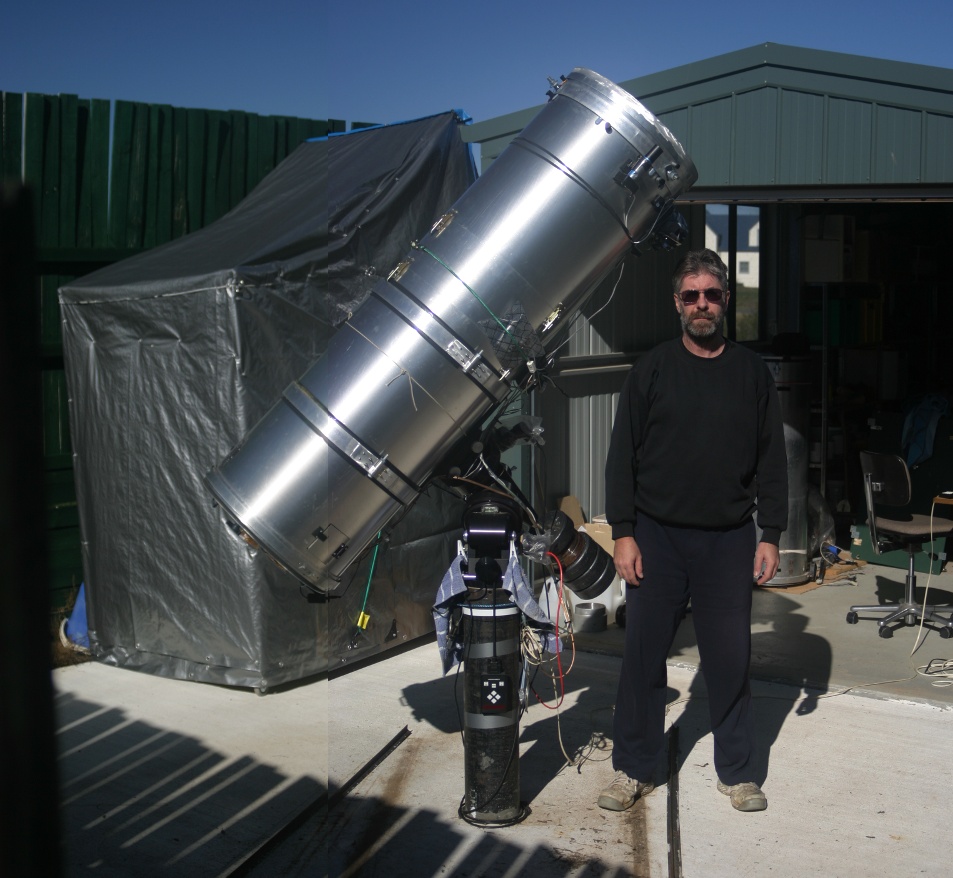
The scope in use was my new 14.5" newtonian, in use now for a few weeks and so far returning excellent images.
I was pleasantly surprised to find reasonable imaging conditions and so I decided to continue recording data until maybe 1am local time. By about midnight (12:10 am) the seeing had deteriorated and I was ready to quit. Indeed I had hovered the mouse over the exit button on my capture application (Coriander for Linux) and then changed my mind and decided instead to simply take a break for 30 minutes and then check back to see if the conditions had improved. It was a very near thing.
When I came back to the scope at about 12:40am I noticed a dark spot rotating into view in Jupiter's south polar region started to get curious. When first seen close to the limb (and in poor conditions) it was only a vaguely dark spot, I thouht likely to be just a normal dark polar storm. However as it rotated further into view, and the conditions improved I suddenly realized that it wasn't just dark, it was black in all channels, meaning it was truly a black spot.
My next thought was that it must be either a dark moon (like Callisto) or a moon shadow, but it was in the wrong place and the wrong size. Also I'd noticed it was moving too slow to be a moon or shadow. As far as I could see it was rotating in sync with a nearby white oval storm that I was very familiar with - this could only mean that the back feature was at the cloud level and not a projected shadow from a moon. I started to get excited.
It took another 15 minutes to really believe that I was seeing something new - I'd imaged that exact region only 2 days earlier and checking back to that image showed no sign of any anomalous black spot.
Now I was caught between a rock and a hard place - I wanted to keep imaging but also I was aware of the importance of alerting others to this possible new event. Could it actually be an impact mark on Jupiter? I had no real idea, and the odds on that happening were so small as to be laughable, but I was really struggling to see any other possibility given the location of the mark. If it really was an impact mark then I had to start telling people, and quickly. In the end I imaged for another 30 minutes only because the conditions were slowly improving and each capture was giving a slightly better image than the last.
Eventually I stopped imaging and went up to the house to start emailing people, with this image above processed as quick and dirty as possible just to have something to show.
More images will come along from me and many other people in the next few days.
*NOTE* Priority is being given to processing and uploading images as fast as possible, so the image quality is no necessarily as good as it might be. When time permits these images will be replaced by higher quality versions. Anthony
More Images:
Closeup of this region in green light only, from reprocessed data (155537UTC). 3 small dark spots can be seen.
Same closeup as previous (155537UTC) , now in colour. 3 small dark spots can be seen in addition to the main one, possibly more. Still looking for better quality raw data from other imaging runs around this time.
Earlier image showing the impact zone in slightly better seeing, but unfortunately the site itself is not as well resolved due to the viewing angle.
This is a very early image of the dark spot, red channel data only. It's just visible on the limb to the upper right. I haven't seen any images showing this impact site on the previous rotation so it's possible that this is the earliest recorded image of the event. Of course, it wasn't visible to me at the time I was recording the data, and after this sequence was captured I took a 30 minute break away from the scope... When I came back I noticed the dark spot.
A later image in reasonable seeing.
One of the last images from this session, this image has been more carefully processed to avoid artifacts by using 3x upsampling on the data before alignment and stacking.
In the early days of the Cold War, three men claim they were chosen by a powerful new government agency to undertake a historically perilous journey. They claim this well-funded operation was staffed with the best scientists and engineers using technology pioneered by the Nazis, and they created the most powerful machine ever built.
In July of 1969, they claim, they climbed aboard an enormous rocket assembled in a Florida swamp, and were sent hurtling at incredible speeds into the sky … all the way to the Moon! Two of them even claim they landed on the Moon, got out, and walked around!
And what prize did they bring back from this momentous journey? Well … they have a bunch of black and white photos of unidentifiable persons in bulky white spacemen costumes in a field of gravel (but curiously without any stars in the black sky) -- and several bags of gray, dusty rocks.
Put that way, the story of the Apollo program can sound pretty far-fetched.
But why should we believe the stories? What evidence is there, really, that the Apollo program landed men on the Moon and brought them back?
Phil Plait, an astronomer at Sonoma University in California, and the Web master of BadAstronomy.com, has his reasons.
If I were trying to fake this, I would put stars in the image," he said referring to the complaint made by hoax proponents that the Apollo photos lack stars. If this had been an oversight, he said, it's an amazingly stupid thing to have forgotten, considering the scope of the "hoax."
Not to mention that with the way cameras work, photographing stars under those conditions would have been nearly impossible.
"If you do know about physics and photographs, you can see these arguments are all ridiculous," Plait said.
So why do people even give an idea like this a second thought?
"I'm not exactly sure," said Plait, "Michael Shermer is a renowned skeptic… and he has a list of reasons (such as) we have an innate thing inside of our brain, we have a need to believe."
"But one thing he leaves off, is that some of these things are just believable. If you don't know much physics, these arguments might sound convincing."
Besides, Plait says the political realities of the time would have made a fraud of that scale almost impossible to pull off.
"We went to the moon to beat the Soviets. If the Soviets had suspected that we faked these missions in any way, they would have been screaming at the top of their lungs."
Number 10: Apollo Hoax Theories: Fluttering Flag The Claim: The American flag appears to wave in the lunar wind.
The Science: If you look closely, you will notice the flag's edges are pulled taut. This effect, which was done purposely as to not allow the flag to just hang flat, it was created by inserting a stiff wire into the fabric. The "flutter" was created as the astronauts worked to erect the flag. As the wire was adjusted, "Old Glory" appeared to wave.
Number 9: Apollo Hoax Theories: Glow-in-the-Dark Astronauts
The Claim: If the astronauts had left the safety of the Van Allen Belt the radiation would have killed them.
The Science: The Van Allen Belts are created by Earth's magnetic field, and protect the planet from dangerous solar radiation. The belts collects this radiation, and traps it in a layer surrounding the Earth. But unless you deliberately caused your spaceship to hover within this layer, for many hours or days, the radiation exposure is well below dangerous levels. The Apollo astronauts passed through the Belts in less than four hours total for the trip. "It's not much more serious than getting a chest x-ray," said Plait. Outside the belt, the radiation drops to low levels that are only dangerous over extremely long periods of time.
Number 8: Apollo Hoax Theories: The Shadow Knows
The Claim: Multiple-angle shadows in the Moon photos prove there was more than one source of light, like a large studio lamp.
The Science: The astronauts were taking their photos on a hilly, brightly-lit landscape while the Sun was close to the horizon. Imagine taking a photograph of someone on a rolling, uneven field of snow during a full, low-hanging Moon. The contours of the ground would produce shadows of many different lengths.
Number 7: Apollo Hoax Theories: Fried Film
The Claim: In the Sun, the Moon's temperature is toasty 280 degrees F. The film (among other things) would have melted.
The Science: No one was leaving bare film out on the hot lunar surface. All material was contained in protective canisters. In addition, at the time the Apollo missions landed, they were either at lunar dawn or dusk. As a result, the temperature was more easily manageable.
Number 6: Apollo Hoax Theories: Liquid Water on the Moon
The Claim: To leave a footprint requires moisture in the soil, doesn't it?
The Science: Not always. If you take some dry fine-grained dust such as talcum powder and dump it out, it's easy to make tracks in it that hold their shape. The particles hold their positions due to the friction between them.
Number 5: Apollo Hoax Theories: Death by Meteor
The Claim: Space is filled with super-fast micro meteors that would punch through the ship and kill the astronauts.
The Science: Space is really amazingly big. While there are indeed an uncountable number of tiny pieces of debris travelling through the Solar System at speeds in the neighborhood of 120,000MPH, the volume of space keeps the density low. The chance of any given cubic yard of space having a micro-meteor passing through it is incredibly close to zero. Additionally, the astronauts suits included a layer of kevlar to protect them from any tiny fragment they might encounter.
Number 4: Apollo Hoax Theories: No Crater at Landing Site
The Claim: When the Lunar Excursion Module (LEM) landed, its powerful engine didn't burrow a deep crater in the "dusty surface."
The Science: Beneath the layer of dust, the Moon is made of fairly densely-packed rock. What dust and loose dirt there was though, was "kicked up" as referenced by the astronauts and captured in their landing films.
Number 3: Apollo Hoax Theories: Phantom Cameraman
The Claim: How come in that one video of the LEM leaving the surface, the camera follows it up into the sky? Who was running that camera?
The Science: The camera was controlled remotely from Earth.
Number 2: Apollo Hoax Theories: Big Rover
The Claim: There's no way that big moon buggy they were driving could have fit into that little landing module!
The Science: The rover was very cleverly constructed to be made out of very light materials, and designed to fold up to about the size of a large suitcase.
Number 1: Apollo Hoax Theories: Its Full of Stars!
The Claim: Space is littered with little points of lights (stars). Why then are they missing from the photographs?
The Science: If you've ever taken a photograph outside at night, you'll notice that faint distant objects don't show up. That's not because the air blocks them -- it's because the brightness of the nearby objects washes out the film. In fact if you were standing on the day side of the Moon, you'd have to somehow block the landscape out in order for your eyes to adapt enough to pick out the stars.
The global warming hoax has proved to be, if nothing else, a topic that should be openly debated instead of being considered off-limits by the climate change activists. Over the last year, I’ve compiled well over 1500 news articles that portray global warming an an inexact science at best and its proponents as being tax-seeking and lifestyle-controlling and, all the while, sometimes even displaying their own hypocrisy and arrogance. Enjoy the year-in-review.
And speaking of weather, let’s not forget the Gore Effect. It seemed in 2008 that every time some big global warming event took place, extreme weather followed:
What about taxes and lifestyle changes? After all, I’m a firm believer that the whole global warming hoax is based around taking your hard-earned money and controlling your lifestyle. What have we learned over the last year about these subjects?
Speaking of gasoline, the global warming alarmists were big on ethanol mandates this year which, quite frankly, caused food prices to skyrocket. The same group of individuals that vowed to protect the poor and sick only hurt them as food riots broke out.
All in all, 2008 has been better for skeptics than warming alarmists. With cold temperatures blanketing the globe during the Winter of 2007 and so far in the Winter of 2008, and planetary temperatures continuing their fall from their most recent high in 1998 even as greenhouse gas emissions rise, the evidence against anthropogenic sources of global warming mounts. But, as many of us know from experiences during our lifetimes, if one tells a lie enough, it becomes truth. I want to keep showing the lies here at Skeptics Global Warming and ensure that they do not become truth. Thank you for visiting during the course of the year. I look forward to another exciting 12 months of spreading the real truth about global warming.


 Located some 20 light-years from Earth, Gliese 581 is among the hundred closest stars to us. Already scientists have detected six planets orbiting the red dwarf, making Gliese 581 the hub of the largest known planetary system outside our solar system.