Showing posts with label universe. Show all posts

Sunday, September 6, 2009

New Exoplanet Orbits 'Backwards'

0 comments

By Paul Rincon
Science reporter, BBC News

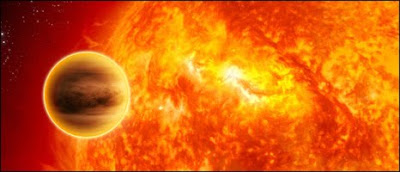
Astronomers have discovered the first planet that orbits in the opposite direction to the spin of its star.

Planets form out of the same swirling gas cloud that creates a star, so they are expected to orbit in the same direction that the star rotates.
The new planet is thought to have been flung into its "retrograde" orbit by a close encounter with either another planet or with a passing star.

The work has been submitted to the Astrophysical Journal for publication.

Co-author Coel Hellier, from Keele University in Staffordshire, UK, said planets with retrograde orbits were thought to be rare.

"With everything [in the star system] swirling around the same way and the star spinning the same way, you have to do quite a lot to it to make it go in the opposite direction," he told BBC News.

The direction of orbit is known for roughly a dozen exoplanets (planets outside our solar system). This is the only example with a retrograde orbit. All others are prograde; they orbit in the same direction as the spin of their star.

Close Encounters

Professor Hellier said a near-collision was probably responsible for this planet's unusual orbit.

"If you have a near-collision, then you'll have a large gravitational slingshot from that interaction," he explained.

"This is the likeliest explanation. But it might be possible you can do it by gradually perturbing the orbit through the influence of a second planet. So far, we haven't found any evidence of a second planet there."

The new object has been named WASP-17b. It is the 17th exoplanet to have been discovered by the Wide Area Search for Planets (WASP) consortium of UK universities.

The gas giant is about twice the size of Jupiter, but has about half the mass. This bloatedness might also be rooted in the close encounter that changed the planet's direction.

WASP-17b was detected using an array of cameras set up to monitor hundreds of thousands of stars.

Astronomers were searching for small dips in light from these stars that occur when a planet passes in front of them. When this happens, the planets are said to transit their parent star.

A team from Geneva Observatory in Switzerland then looked for spectral signs that the star was wobbling due to gravitational tugs from an orbiting planet.

"If you look at how the spectrum of the star changes when the planet transits across it, you can work out which way the planet is travelling," Professor Hellier added.

"That allows you to prove that it's in a retrograde orbit."

The size of the dip in light from the star during the transit allowed astronomers to work out the planet's radius.

To work out how massive it was, they recorded the motion of the star as it was tugged on by the orbiting planet.

Paul.Rincon-INTERNET@bbc.co.uk

Source : BBC News

Friday, February 1, 2008

NASA to Beam Beatles' 'Across the Universe' Into Space

0 comments

For the first time ever, NASA will beam a song -- The Beatles' "Across the Universe" (Listen) -- directly into deep space at 7 p.m. EST on Feb. 4.

The transmission over NASA's Deep Space Network will commemorate the 40th anniversary of the day The Beatles recorded the song, as well as the 50th anniversary of NASA's founding and the group's beginnings. Two other anniversaries also are being honored: The launch 50 years ago this week of Explorer 1, the first U.S. satellite, and the founding 45 years ago of the Deep Space Network, an international network of antennas that supports missions to explore the universe.

The transmission is being aimed at the North Star, Polaris, which is located 431 light years away from Earth. The song will travel across the universe at a speed of 186,000 miles per second. Former Beatle Sir Paul McCartney expressed excitement that the tune, which was principally written by fellow Beatle John Lennon, was being beamed into the cosmos.

"Amazing! Well done, NASA!" McCartney said in a message to the space agency. "Send my love to the aliens. All the best, Paul."

Lennon's widow, Yoko Ono, characterized the song's transmission as a significant event.

"I see that this is the beginning of the new age in which we will communicate with billions of planets across the universe," she said.

It is not the first time Beatles music has been used by NASA; in November 2005, McCartney performed the song "Good Day Sunshine" during a concert that was transmitted to the International Space Station (› Related Story). "Here Comes the Sun," "Ticket to Ride" and "A Hard Day's Night" are among other Beatles' songs that have been played to wake astronaut crews in orbit.

Feb. 4 has been declared "Across The Universe Day" by Beatles fans to commemorate the anniversaries. As part of the celebration, the public around the world has been invited to participate in the event by simultaneously playing the song at the same time it is transmitted by NASA. Many of the senior NASA scientists and engineers involved in the effort are among the group's biggest fans.

"I've been a Beatles fan for 45 years – as long as the Deep Space Network has been around," said Dr. Barry Geldzahler, the network's program executive at NASA Headquarters, Washington. "What a joy, especially considering that 'Across the Universe' is my personal favorite Beatles song."

Source : NASA

Thursday, January 31, 2008

Astronomers' Findings Portray Odd, Violent Universe: Rogue Black Holes, Orphaned Baby Stars

0 comments

WASHINGTON (AP) - The deeper astronomers gaze into the cosmos, the more they find it's a bizarre and violent universe. The research findings from this week's annual meeting of U.S. astronomers range from blue orphaned baby stars to menacing "rogue" black holes that roam our galaxy, devouring any planets unlucky enough to be within their limited reach.

"It's an odd universe we live in," said Vanderbilt University astronomer Kelly Holley-Bockelmann. She presented her theory on rogue black holes at the American Astronomical Society's meeting in Austin, Texas, earlier this week.

It should be noted that she's not worried and you shouldn't be either. The odds of one of these black holes swallowing up Earth or the sun or wreaking other havoc is somewhere around 1 in 10 quadrillion in any given year.

"This is the glory of the universe," added J. Craig Wheeler, president of the astronomy association. "What is odd and what is normal is changing." Just five years ago, astronomers were gazing at a few thousand galaxies where stars formed in a bizarre and violent manner. Now the number is in the millions, thanks to more powerful, telescopes and supercomputers to crunch the crucial numbers streaming in from space, said Wheeler, a University of Texas astronomer.

Scientists are finding that not only are they improving their understanding of the basic questions of the universe such as how did it all start and where is it all going they also keep stumbling upon unexpected, hard-to-explain cosmic quirks and the potential, but comfortably distant, dangers.

Much of what they keep finding plays out like a stellar version of a violent Quentin Tarantino movie. The violence surrounds and approaches Earth, even though our planet is safe and "in a pretty quiet neighborhood," said Wheeler, author of the book "Cosmic Catastrophes."

One example is an approaching gas cloud discussed at the meeting Friday. The cloud has a mass 1 million times that of the sun. It is 47 quadrillion miles away. But it's heading toward our Milky Way galaxy at 150 miles per second. And when it hits, there will be fireworks that form new stars and "really light up the neighborhood," said astronomer Jay Lockman at the National Radio Astronomy Observatory in West Virginia.

But don't worry. It will hit a part of the Milky Way far from Earth and the biggest collision will be 40 million years in the future.

The giant cloud has been known for more than 40 years, but only now have scientists realized how fast it's moving. So fast, Lockman said, that "we can see it sort of plowing up a wave of galactic material in front of it."

When astronomers this week unveiled a giant map of mysterious dark matter in a supercluster of galaxies, they explained that the violence of the cramped-together galaxies is so great that there is now an accepted vocabulary for various types of cosmic brutal behavior.

The gravitational force between the clashing galaxies can cause "slow strangulation," in which crucial gas is gradually removed from the victim galaxy. "Stripping" is a more violent process in which the larger galaxy rips gas from the smaller one. And then there's "harassment," which is a quick fly-by encounter, said astronomer Meghan Gray of the University of Nottingham in the United Kingdom.

Gray's presentation essentially showed the victims of galaxy-on-galaxy violence. She and her colleagues are trying to figure out the how the dirty deeds were done.

In the past few days, scientists have unveiled plenty to ooh and aah over:


Photos of "blue blobs" that astronomers figure are orphaned baby stars. They're called orphans because they were "born in the middle of nowhere" instead of within gas clouds, said Catholic University of America astronomer Duilia F. de Mello.


A strange quadruplet of four hugging stars, which may eventually help astronomers understand better how stars form.

A young star surrounded by dust, that may eventually become a planet. It's nicknamed "the moth," because the interaction of star and dust are shaped like one.

A spiral galaxy with two pairs of arms spinning in opposite directions, like a double pinwheel. It defies what astronomers believe should happen. It is akin to one of those spinning-armed flamingo lawn ornaments, said astronomer Gene Byrd of the University of Alabama.

The equivalent of post-menopausal stars giving unlikely birth to new planets. Most planets form soon after a sun, but astronomers found two older stars"Intellectually and spiritually, if I can use that word with a lower case 's,' it's awe-inspiring," Wheeler said. "It's a great universe.", one at least 400 million years old, with new planets.

Source : PR-inside.com

Big Brain Theory: Have Cosmologists Lost Theirs?

0 comments

By Dennis Overbye

Correction Appended

It could be the weirdest and most embarrassing prediction in the history of cosmology, if not science.

If true, it would mean that you yourself reading this article are more likely to be some momentary fluctuation in a field of matter and energy out in space than a person with a real past born through billions of years of evolution in an orderly star-spangled cosmos. Your memories and the world you think you see around you are illusions.

This bizarre picture is the outcome of a recent series of calculations that take some of the bedrock theories and discoveries of modern cosmology to the limit. Nobody in the field believes that this is the way things really work, however. And so in the last couple of years there has been a growing stream of debate and dueling papers, replete with references to such esoteric subjects as reincarnation, multiple universes and even the death of spacetime, as cosmologists try to square the predictions of their cherished theories with their convictions that we and the universe are real. The basic problem is that across the eons of time, the standard theories suggest, the universe can recur over and over again in an endless cycle of big bangs, but it’s hard for nature to make a whole universe. It’s much easier to make fragments of one, like planets, yourself maybe in a spacesuit or even — in the most absurd and troubling example — a naked brain floating in space. Nature tends to do what is easiest, from the standpoint of energy and probability. And so these fragments — in particular the brains — would appear far more frequently than real full-fledged universes, or than us. Or they might be us.

Alan Guth, a cosmologist at the Massachusetts Institute of Technology who agrees this overabundance is absurd, pointed out that some calculations result in an infinite number of free-floating brains for every normal brain, making it “infinitely unlikely for us to be normal brains.” Welcome to what physicists call the Boltzmann brain problem, named after the 19th-century Austrian physicist Ludwig Boltzmann, who suggested the mechanism by which such fluctuations could happen in a gas or in the universe. Cosmologists also refer to them as “freaky observers,” in contrast to regular or “ordered” observers of the cosmos like ourselves. Cosmologists are desperate to eliminate these freaks from their theories, but so far they can’t even agree on how or even on whether they are making any progress.

If you are inclined to skepticism this debate might seem like further evidence that cosmologists, who gave us dark matter, dark energy and speak with apparent aplomb about gazillions of parallel universes, have finally lost their minds. But the cosmologists say the brain problem serves as a valuable reality check as they contemplate the far, far future and zillions of bubble universes popping off from one another in an ever-increasing rush through eternity. What, for example is a “typical” observer in such a setup? If some atoms in another universe stick together briefly to look, talk and think exactly like you, is it really you?

“It is part of a much bigger set of questions about how to think about probabilities in an infinite universe in which everything that can occur, does occur, infinitely many times,” said Leonard Susskind of Stanford, a co-author of a paper in 2002 that helped set off the debate. Or as Andrei Linde, another Stanford theorist given to colorful language, loosely characterized the possibility of a replica of your own brain forming out in space sometime, “How do you compute the probability to be reincarnated to the probability of being born?”

The Boltzmann brain problem arises from a string of logical conclusions that all spring from another deep and old question, namely why time seems to go in only one direction. Why can’t you unscramble an egg? The fundamental laws governing the atoms bouncing off one another in the egg look the same whether time goes forward or backward. In this universe, at least, the future and the past are different and you can’t remember who is going to win the Super Bowl next week.

“When you break an egg and scramble it you are doing cosmology,” said Sean Carroll, a cosmologist at the California Institute of Technology.

Boltzmann ascribed this so-called arrow of time to the tendency of any collection of particles to spread out into the most random and useless configuration, in accordance with the second law of thermodynamics (sometimes paraphrased as “things get worse”), which says that entropy, which is a measure of disorder or wasted energy, can never decrease in a closed system like the universe.

If the universe was running down and entropy was increasing now, that was because the universe must have been highly ordered in the past.

In Boltzmann’s time the universe was presumed to have been around forever, in which case it would long ago have stabilized at a lukewarm temperature and died a “heat death.” It would already have maximum entropy, and so with no way to become more disorderly there would be no arrow of time. No life would be possible but that would be all right because life would be excruciatingly boring. Boltzmann said that entropy was all about odds, however, and if we waited long enough the random bumping of atoms would occasionally produce the cosmic equivalent of an egg unscrambling. A rare fluctuation would decrease the entropy in some place and start the arrow of time pointing and history flowing again. That is not what happened. Astronomers now know the universe has not lasted forever. It was born in the Big Bang, which somehow set the arrow of time, 14 billion years ago. The linchpin of the Big Bang is thought to be an explosive moment known as inflation, during which space became suffused with energy that had an antigravitational effect and ballooned violently outward, ironing the kinks and irregularities out of what is now the observable universe and endowing primordial chaos with order.

Inflation is a veritable cosmological fertility principle. Fluctuations in the field driving inflation also would have seeded the universe with the lumps that eventually grew to be galaxies, stars and people. According to the more extended version, called eternal inflation, an endless array of bubble or “pocket” universes are branching off from one another at a dizzying and exponentially increasing rate. They could have different properties and perhaps even different laws of physics, so the story goes.

A different, but perhaps related, form of antigravity, glibly dubbed dark energy, seems to be running the universe now, and that is the culprit responsible for the Boltzmann brains.

The expansion of the universe seems to be accelerating, making galaxies fly away from one another faster and faster. If the leading dark-energy suspect, a universal repulsion Einstein called the cosmological constant, is true, this runaway process will last forever, and distant galaxies will eventually be moving apart so quickly that they cannot communicate with one another. Being in such a space would be like being surrounded by a black hole.

Rather than simply going to black like “The Sopranos” conclusion, however, the cosmic horizon would glow, emitting a feeble spray of elementary particles and radiation, with a temperature of a fraction of a billionth of a degree, courtesy of quantum uncertainty. That radiation bath will be subject to random fluctuations just like Boltzmann’s eternal universe, however, and every once in a very long, long time, one of those fluctuations would be big enough to recreate the Big Bang. In the fullness of time this process could lead to the endless series of recurring universes. Our present universe could be part of that chain.

In such a recurrent setup, however, Dr. Susskind of Stanford, Lisa Dyson, now of the University of California, Berkeley, and Matthew Kleban, now at New York University, pointed out in 2002 that Boltzmann’s idea might work too well, filling the megaverse with more Boltzmann brains than universes or real people.

In the same way the odds of a real word showing up when you shake a box of Scrabble letters are greater than a whole sentence or paragraph forming, these “regular” universes would be vastly outnumbered by weird ones, including flawed variations on our own all the way down to naked brains, a result foreshadowed by Martin Rees, a cosmologist at the University of Cambridge, in his 1997 book, “Before the Beginning.”

The conclusions of Dr. Dyson and her colleagues were quickly challenged by Andreas Albrecht and Lorenzo Sorbo of the University of California, Davis, who used an alternate approach. They found that the Big Bang was actually more likely than Boltzmann’s brain.

“In the end, inflation saves us from Boltzmann’s brain,” Dr. Albrecht said, while admitting that the calculations were contentious. Indeed, the “invasion of Boltzmann brains,” as Dr. Linde once referred to it, was just beginning.

In an interview Dr. Linde described these brains as a form of reincarnation. Over the course of eternity, he said, anything is possible. After some Big Bang in the far future, he said, “it’s possible that you yourself will re-emerge. Eventually you will appear with your table and your computer.”

But it’s more likely, he went on, that you will be reincarnated as an isolated brain, without the baggage of stars and galaxies. In terms of probability, he said, “It’s cheaper.”

You might wonder what’s wrong with a few brains — or even a preponderance of them — floating around in space. For one thing, as observers these brains would see a freaky chaotic universe, unlike our own, which seems to persist in its promise and disappointment.

Another is that one of the central orthodoxies of cosmology is that humans don’t occupy a special place in the cosmos, that we and our experiences are typical of cosmic beings. If the odds of us being real instead of Boltzmann brains are one in a million, say, waking up every day would be like walking out on the street and finding everyone in the city standing on their heads. You would expect there to be some reason why you were the only one left right side up.

Some cosmologists, James Hartle and Mark Srednicki, of the University of California, Santa Barbara, have questioned that assumption. “For example,” Dr. Hartle wrote in an e-mail message, “on Earth humans are not typical animals; insects are far more numerous. No one is surprised by this.”

In an e-mail response to Dr. Hartle’s view, Don Page of the University of Alberta, who has been a prominent voice in the Boltzmann debate, argued that what counted cosmologically was not sheer numbers, but consciousness, which we have in abundance over the insects. “I would say that we have no strong evidence against the working hypothesis that we are typical and that our observations are typical,” he explained, “which is very fruitful in science for helping us believe that our observations are not just flukes but do tell us something about the universe.”

Dr. Dyson and her colleagues suggested that the solution to the Boltzmann paradox was in denying the presumption that the universe would accelerate eternally. In other words, they said, that the cosmological constant was perhaps not really constant. If the cosmological constant eventually faded away, the universe would revert to normal expansion and what was left would eventually fade to black. With no more acceleration there would be no horizon with its snap, crackle and pop, and thus no material for fluctuations and Boltzmann brains.

String theory calculations have suggested that dark energy is indeed metastable and will decay, Dr. Susskind pointed out. “The success of ordinary cosmology,” Dr. Susskind said, “speaks against the idea that the universe was created in a random fluctuation.”

But nobody knows whether dark energy — if it dies — will die soon enough to save the universe from a surplus of Boltzmann brains. In 2006, Dr. Page calculated that the dark energy would have to decay in about 20 billion years in order to prevent it from being overrun by Boltzmann brains.

The decay, if and when it comes, would rejigger the laws of physics and so would be fatal and total, spreading at almost the speed of light and destroying all matter without warning. There would be no time for pain, Dr. Page wrote: “And no grieving survivors will be left behind. So in this way it would be the most humanely possible execution.” But the object of his work, he said, was not to predict the end of the universe but to draw attention to the fact that the Boltzmann brain problem remains.

People have their own favorite measures of probability in the multiverse, said Raphael Bousso of the University of California, Berkeley. “So Boltzmann brains are just one example of how measures can predict nonsense; anytime your measure predicts that something we see has extremely small probability, you can throw it out,” he wrote in an e-mail message.

Another contentious issue is whether the cosmologists in their calculations could consider only the observable universe, which is all we can ever see or be influenced by, or whether they should take into account the vast and ever-growing assemblage of other bubbles forever out of our view predicted by eternal inflation. In the latter case, as Alex Vilenkin of Tufts University pointed out, “The numbers of regular and freak observers are both infinite.” Which kind predominate depends on how you do the counting, he said..

In eternal inflation, the number of new bubbles being hatched at any given moment is always growing, Dr. Linde said, explaining one such counting scheme he likes. So the evolution of people in new bubbles far outstrips the creation of Boltzmann brains in old ones. The main way life emerges, he said, is not by reincarnation but by the creation of new parts of the universe. “So maybe we don’t need to care too much” about the Boltzmann brains,” he said.

“If you are reincarnated, why do you care about where you are reincarnated?” he asked. “It sounds crazy because here we are touching issues we are not supposed to be touching in ordinary science. Can we be reincarnated?”

“People are not prepared for this discussion,” Dr. Linde said.

Source : The New York Times

Probing the Cosmic Web of the Universe

0 comments

Astronomers have used ESO’s Very Large Telescope to measure the distribution and motions of thousands of galaxies in the distant Universe. This opens fascinating perspectives to better understand what drives the acceleration of the cosmic expansion and sheds new light on the mysterious dark energy that is thought to permeate the Universe.

“Explaining why the expansion of the Universe is currently accelerating is certainly the most fascinating question in modern cosmology,” says Luigi Guzzo, lead author of a paper in this week’s issue of Nature, in which the new results are presented. “We have been able to show that large surveys that measure the positions and velocities of distant galaxies provide us with a new powerful way to solve this mystery.”

Ten years ago, astronomers made the stunning discovery that the Universe is expanding at a faster pace today than it did in the past.

“This implies that one of two very different possibilities must hold true,” explains Enzo Branchini, member of the team. “Either the Universe is filled with a mysterious dark energy which produces a repulsive force that fights the gravitational brake from all the matter present in the Universe, or, our current theory of gravitation is not correct and needs to be modified, for example by adding extra dimensions to space.”

Current observations of the expansion rate of the Universe cannot distinguish between these two options, but the international team of 51 scientists from 24 institutions found a way that could help in tackling this problem. The technique is based on a well-known phenomenon, namely the fact that the apparent motion of distant galaxies results from two effects: the global expansion of the Universe that pushes the galaxies away from each other and the gravitational attraction of matter present in the galaxies’ neighbourhood that pulls them together, creating the cosmic web of large-scale structures.

“By measuring the apparent velocities of large samples of galaxies over the last thirty years, astronomers have been able to reconstruct a three-dimensional map of the distribution of galaxies over large volumes of the Universe. This map revealed large-scale structures such as clusters of galaxies and filamentary superclusters ”, says Olivier Le Fèvre, member of the team. “But the measured velocities also contain information about the local motions of galaxies; these introduce small but significant distortions in the reconstructed maps of the Universe. We have shown that measuring this distortion at different epochs of the Universe’s history is a way to test the nature of dark energy.”

Guzzo and his collaborators have been able to measure this effect by using the VIMOS spectrograph on Melipal, one of the four 8.2-m telescopes that is part of ESO’s VLT. As part of the VIMOS-VLT Deep Survey (VVDS), of which Le Fèvre is the Principal Investigator, spectra of several thousands of galaxies in a 4-square-degree field (or 20 times the size of the full Moon) at epochs corresponding to about half the current age of the Universe (about 7 billion years ago) were obtained and analysed.

“This is the largest field ever covered homogeneously by means of spectroscopy to this depth,” says Le Fèvre. “We have now collected more than 13,000 spectra in this field and the total volume sampled by the survey is more than 25 million cubic light-years.”

The astronomers compared their result with that of the 2dFGRS survey that probed the local Universe, i.e. measures the distortion at the present time.

Within current uncertainties, the measurement of this effect provides an independent indication of the need for an unknown extra energy ingredient in the ‘cosmic soup’, supporting the simplest form of dark energy, the so-called cosmological constant, introduced originally by Albert Einstein. The large uncertainties do not yet exclude the other scenarios, though.

“We have also shown that by extending our measurements over volumes about ten times larger than the VVDS, this technique should be able to tell us whether cosmic acceleration originates from a dark energy component of exotic origin or requires a modification of the laws of gravity,” said Guzzo.

“VIMOS on the VLT would certainly be a wonderful tool to perform this future survey and help us answer this fundamental question. This strongly encourages our team to proceed with even more ambitious surveys of the distant Universe,” says Le Fèvre.

Source : RedOrbit


The Expanding Universe

In 1929, Edwin Hubble, an astronomer at Caltech, made a critical discovery that soon led to scientific answers for these questions: he discovered that the universe is expanding.

How Fast is the Universe Expanding?
The expansion or contraction of the universe depends on its content and past history. With enough matter, the expansion will slow or even become a contraction.

What is the Universe Expanding Into?
I am very confused about things my science book says about the expanding universe. Every book I have seen has defined the universe as "everything". If the universe is expanding what is it expanding into?

Hubble's Guide to the Expanding Universe

Think you've established your place in the universe? Think again. Your position right now isn't the same as it was just a second ago.

Cosmology Primer: The Expanding Universe

Hubble's second great discovery is that the universe is expanding. The concept of an expanding universe can be a tricky one, so it is worth being careful about what we mean.

Thursday, January 24, 2008

Universe

0 comments

The term Universe has a variety of meanings based on the context in which it is described. In philosophical terms, the Universe is the summation of all that exists and the space in which all events occur. In cosmological terms, the Universe is thought to be a finite or infinite space-time continuum in which all matter and energy exist. (It has been hypothesized by scientists that the Universe is part of a system of many other universes, known as the multiverse.) The terms known Universe, observable Universe, or visible Universe are often used to describe the part of the Universe that can be seen or otherwise observed by humanity. Those who believe it is impossible to observe the whole continuum may use our Universe, referring only to that knowable by human beings in particular.

Expansion and age and the Big Bang theory

The most important result of cosmology, the understanding that the Universe is expanding, is derived from redshift observations and quantified by Hubble's Law. Extrapolating this expansion back in time, one approaches a gravitational singularity, a rather abstract mathematical concept, which may or may not correspond to reality. This gives rise to the Big Bang theory, the dominant model in cosmology today. The age of the Universe from the time of the Big Bang, was estimated to be about 13.7 billion (13.7 × 10⁹) years, with a margin of error of about 1 percent (± 200 million years), according to NASA's WMAP (Wilkinson Microwave Anisotropy Probe). However, this is based on the assumption that the underlying model used for data analysis is correct. Other methods of estimating the age of the Universe give different ages.

A fundamental aspect of the Big Bang can be seen today in the observation that the farther away from us galaxies are, the faster they move away from us. It can also be seen in the cosmic microwave background radiation which is the much-attenuated radiation that originated soon after the Big Bang. This background radiation is remarkably uniform in all directions, which cosmologists have attempted to explain by an early period of inflationary expansion following the Big Bang.

Size of Universe and Observable Universe

There is disagreement over whether the Universe is indeed finite or infinite in spatial extent and volume.

However, the observable Universe, consisting of all locations that could have affected us since the Big Bang given the finite speed of light, is certainly finite. The edge of the cosmic light horizon is 13.7 billion light years (4.19 gpc) distant. The present distance (comoving distance) to the edge of the observable Universe is larger, since the Universe has been expanding; it is estimated to be about 78 billion light years (7.8 × 10¹⁰ light years, or 7.4 × 10²³ km). This would make the comoving volume, of the known Universe, equal to 1.9 × 1033 cubic light years (assuming this region is perfectly spherical). The observable Universe contains about 7 × 10²² stars, organized in about 100 billion galaxies, which themselves form clusters and superclusters. The number of galaxies may be even larger, based on the Hubble Deep Field observed with the Hubble Space Telescope. The Hubble Space Telescope discovered galaxies such as Abell 1835 IR1916, which are over 13 billion light years from Earth.

Both popular and professional research articles in cosmology often use the term "Universe" when they really mean "observable Universe". This is because unobservable physical phenomena are scientifically irrelevant; that is, they cannot affect any events that we can perceive. See also Causality (physics).

We live in the center of the Universe that we observe, in apparent contradiction to the Copernican principle which says that the Universe is more or less uniform and it has no distinguished center. This is simply because light does not travel infinitely fast, and we make observations of the past. As we look further and further away, we see things from epochs (times) closer and closer to the limit of time, which equals zero, according to the Big Bang model. Since light travels at the same speed in any direction towards us, it is reasonable to suggest that we live at the center of our observable Universe.

Shape of the Universe

An important open question of cosmology is the shape of the Universe. Mathematically, which 3-manifold represents best the spatial part of the Universe?

Firstly, whether the Universe is spatially flat, i.e. whether the rules of Euclidean geometry are valid on the largest scales, is unknown. Currently, most cosmologists believe that the observable Universe is very nearly spatially flat, with local wrinkles where massive objects distort spacetime, just as a lake is (nearly) flat. This opinion was strengthened by the latest data from WMAP, looking at "acoustic oscillations" in the cosmic microwave background radiation temperature variations.

Secondly, whether the Universe is multiply connected, is unknown. The Universe has no spatial boundary according to the standard Big Bang model, but nevertheless may be spatially finite (compact). This can be understood using a two-dimensional analogy: the surface of a sphere has no edge, but nonetheless has a finite area. It is a two-dimensional surface with constant curvature in a third dimension. The 3-sphere is a three-dimensional equivalent in which all three dimensions are constantly curved in a fourth.

If the Universe is indeed spatially finite, as described, then traveling in a "straight" line, in any given direction, would theoretically cause one to eventually arrive back at the starting point.

Strictly speaking, we should call the stars and galaxies "views" of stars and galaxies, since it is possible that the Universe is multiply-connected and sufficiently small (and of an appropriate, perhaps complex, shape) that we can see once or several times around it in various, and perhaps all, directions. (Think of a house of mirrors.) If so, the actual number of physically distinct stars and galaxies would be smaller than currently accounted. Although this possibility has not been ruled out, the results of the latest cosmic microwave background research make this appear very unlikely.

Fate of the Universe

Depending on the average density of matter and energy in the Universe, it will either keep on expanding forever or it will be gravitationally slowed down and will eventually collapse back on itself in a "Big Crunch". Currently the evidence suggests not only that there is insufficient mass/energy to cause a recollapse, but that the expansion of the Universe seems to be accelerating and will accelerate for the whole of eternity (see accelerating Universe). Other ideas of the fate of our Universe include the Big Rip, the Big Freeze, and Heat Death of the Universe theory.

Multiverse

There is some speculation that multiple universes exist in a higher-level multiverse (also known as a megaverse), our Universe being one of those universes (lower case). For example, matter that falls into a black hole in our Universe could emerge as a Big Bang, starting another universe. However, all such ideas are currently untestable and cannot be regarded as anything more than speculation. The concept of parallel universes are understood only when related to string theory.

Other terms

Different words have been used throughout history to denote "all of space", including the equivalents and variants in various languages of "heavens", "cosmos", and "world". Macrocosm has also been used to this effect, although it is more specifically defined as a system that reflects in large scale one, some, or all of its component systems or parts. (Similarly, a microcosm is system that reflects in small scale a much larger system of which it is a part.)

Although words like world and its equivalents in other languages now almost always refer to the planet Earth, they previously referred to everything that exists—see Copernicus, for example—and still sometimes do (as in "the whole wide world"). Some languages use the word for "world" as part of the word for "outer space", e.g. in the German word "Weltall".

Source : The Global Oneness Commitment


The Birth of the Universe

What started the big bang? How did space, time, matter and energy take the forms that we see today? Can we work backward to unravel the history of the universe?

When and How Did This Universe Begin?
Closer To Truth is the definitive television series on Cosmos, Consciousness and God, a global journey in search of the vital ideas of existence.

How Did The Universe Start?

A basic look at the Universe and the Big Bang for the non-specialist.

How Did This Universe Begin?
Humanity's ancient and perpetual fascination with the universe's beginnings is discussed in light of recent, revolutionary discoveries in cosmology, and what they mean for human understanding.

Did the Universe Have a Beginning?
Despite the widespread acceptance of the big bang theory as a working model for interpreting new findings, not a single important prediction of the theory has yet been confirmed, and substantial evidence has accumulated against it. Here, we examine the evidence for the most fundamental postulate of the big bang, the expansion of the universe.

Related Links


Copyright 2008 All Rights Reserved Revolution Two Church theme by Brian Gardner Converted into Blogger Template by Bloganol dot com